Facts checked against sources
I check job titles, education, dates, and links against reviewed sources and keep those details consistent across the site.
Portfolio case study
I designed and developed this site with Codex to bring my experience, education, project work, and résumé into one public record.
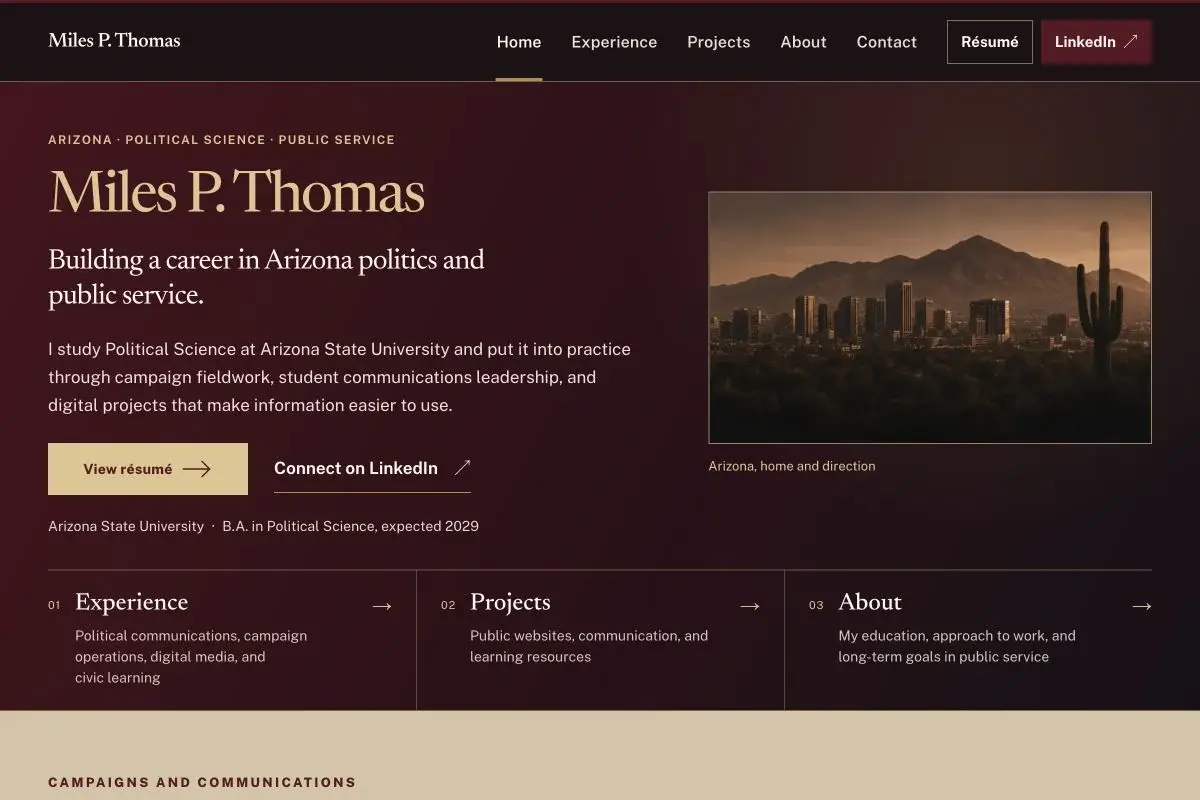
I kept the Arizona landscape and cream-and-oxblood identity while giving the introduction, résumé access, and route index distinct places in the layout. Captured October 18, 2026.
Open the homepageObjective
I wanted visitors to understand my experience, education, and future goals, then find my résumé and public profiles easily. The site also makes clear that it is my personal portfolio and does not speak for a campaign or public office.
Design decisions
Execution
Every page and the public résumé should be clear, consistent, easy to use, and respectful of privacy.
I check job titles, education, dates, and links against reviewed sources and keep those details consistent across the site.
A web résumé supports quick reading, while a separate prepared PDF provides a complete two-page document for downloading and printing.
I check routes, links, navigation, metadata, and responsive layouts before a release, and keep the prepared PDF separate from browser-command printing.
Outcome
Visitors can identify my current role, understand my ASU preparation and Arizona public-service direction, and move directly to detailed experience, the public résumé, or LinkedIn.
Portfolio details
A personal professional portfolio centered on Arizona politics, campaign operations, ASU, and public service.
Warm cream, deep oxblood, charcoal, restrained antique gold, Newsreader, and Public Sans establish a civic-editorial identity.
Semantic landmarks, keyboard access, visible focus, responsive reflow, reduced-motion support, and résumé print styles guide the experience. Private contact and campaign information remain excluded.
I direct the content, design, and development with Codex. The site uses Next.js, React, TypeScript, and custom CSS, with self-hosted fonts and Netlify hosting. AI assistance is part of the process; I remain responsible for the content and the checks before publication.
Palette
#171116#5A1724#D8C3A7#B88A44Typography
NewsreaderArizona public service
Public SansClear information, built for access.